
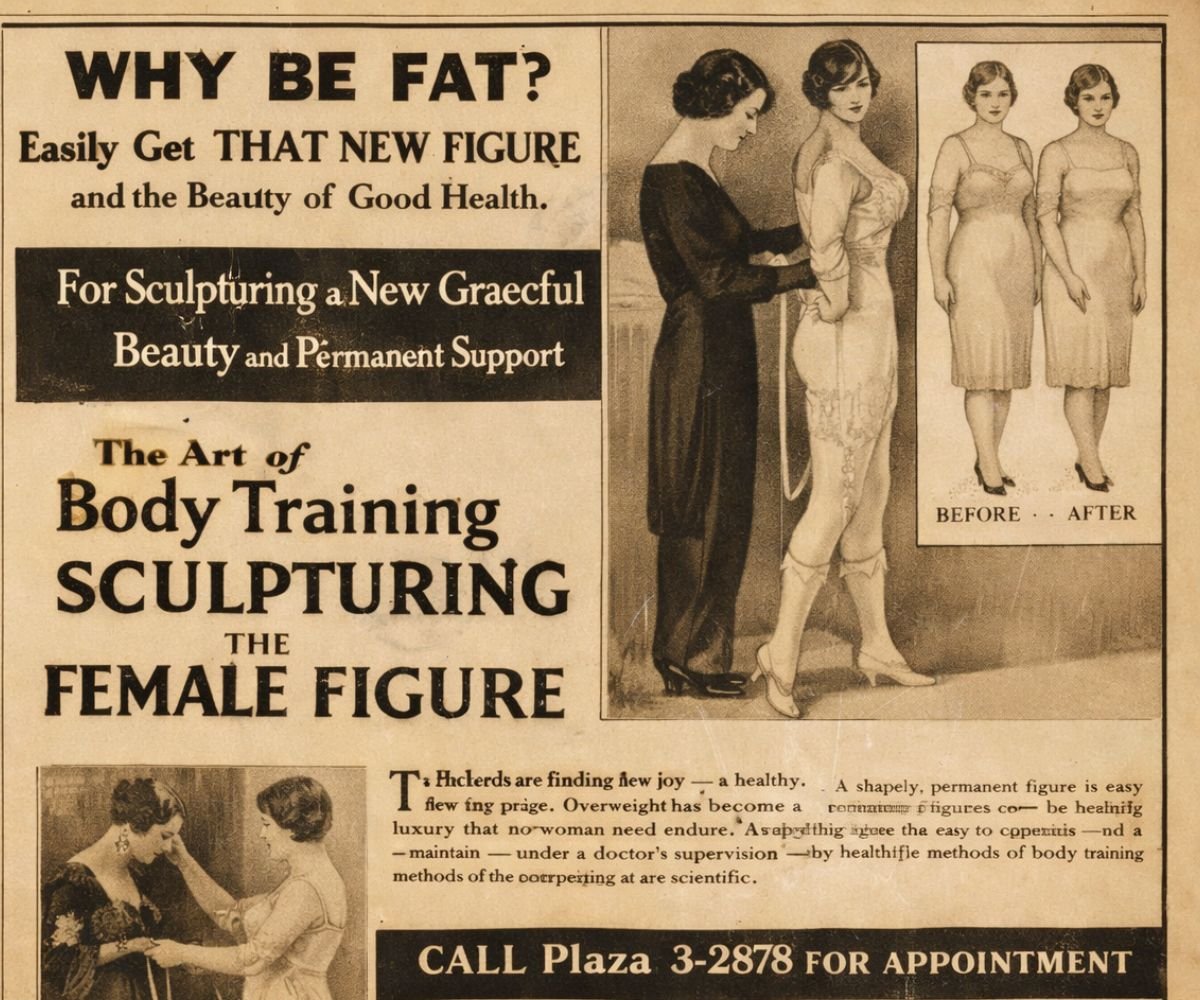
Within the crowded pages of fashion magazines in the 1920s, beauty was not defined merely by hemlines and silhouettes. Between the fashion plates and articles about Paris, a new promise was being constructed, one that did not speak of beauty at all, but of the body. Names and titles that spoke of medicine and science began to be included alongside beauty solutions, suggesting that beauty and femininity could be designed and constructed as precisely as any garment. One such name was Dr. Jeanne B. Walter, who appeared in advertisements for beauty solutions designed to reshape the female figure.
Whether she was presented as a physician, a specialist, or simply a name with a title, the fact remained that the inclusion of the word “Dr”. was part of the appeal. The early twentieth century was an era when anything associated with “science” or “medicine” was considered forward-thinking, modern, and credible. The merging of medicine and beauty moved appearance out of the realm of taste and into the realm of necessity. Beauty and appearance no longer merely had to be fashionable; they had to be necessary.
The 1920s provided the perfect environment for such an appeal. The fashionable figure of the era emphasized youth and slenderness, with straight lines and flat curves considered desirable. This shift occurred at a time when media and consumer culture were rapidly expanding. The media did not merely present the slimmer figure as desirable; it also created a marketplace of solutions, a quick fix culture designed to help women attain that look.
At this stage, the nature of these advertisements becomes clear. Classified sections offered a variety of extreme “last resort” devices, promising practical solutions to unwanted flesh. These advertisements promoted rubber reducing garments, corsets, and other devices meant to be worn tightly against the body. The name of Dr. Jeanne B. Walter stood out because of the specificity of the products associated with her. In addition to weight-reducing corsets and girdles made of rubber, the advertisements described items designed to target specific areas of the body, such as the ankles, which were more visible due to shorter skirts, the chin, to reduce fullness under the jaw, and the body more generally for comprehensive reduction. The logic behind these products relied on ideas of friction, heat, and sweating, based on the notion that the body could be compelled to lose unwanted weight.
View this post on Instagram
The important consideration here is not the ingenuity or absurdity of these devices, but the cultural moment they represent. Beauty, as framed through figures like Dr. Jeanne B. Walter, began to borrow the rhetoric of treatment. The body, in this sense, came to be seen as something to be managed, corrected, and disciplined, with purchasable solutions offered for perceived problems. Fashion imagery provided the standard, and the accompanying advertisements suggested that the inability to meet this standard was itself a condition requiring treatment.
This transformation also reflects the broader tensions of modernity. Women’s lives were changing, cities were expanding, and new forms of visibility emerged. The ankle, once hidden, suddenly became an object of concern. The chin, waist, and hips likewise became sites of isolation, evaluation, and intervention. Products associated with a medical persona implied that personal appearance was as optimizable as health or efficiency.
While the rubber garments and reduction clothing of the era fell out of favor in the 1930s, the attitude they embodied endured. Later decades introduced new materials, new terminology, and more sophisticated technologies, but the underlying promise remained consistent. There would always be a device, garment, or system positioned between the body as it is and the body as fashion imagines it should be.
In this way, Dr. Jeanne B. Walter represents less a relic of the past than a symbol of a particular historical moment. It was a moment when beauty, consumerism, and medicine converged in the pages of fashion magazines, and when the modern idea of the body as something adjustable, something that could be brought closer to an ideal through the purchase of a device or system, began to take hold.