
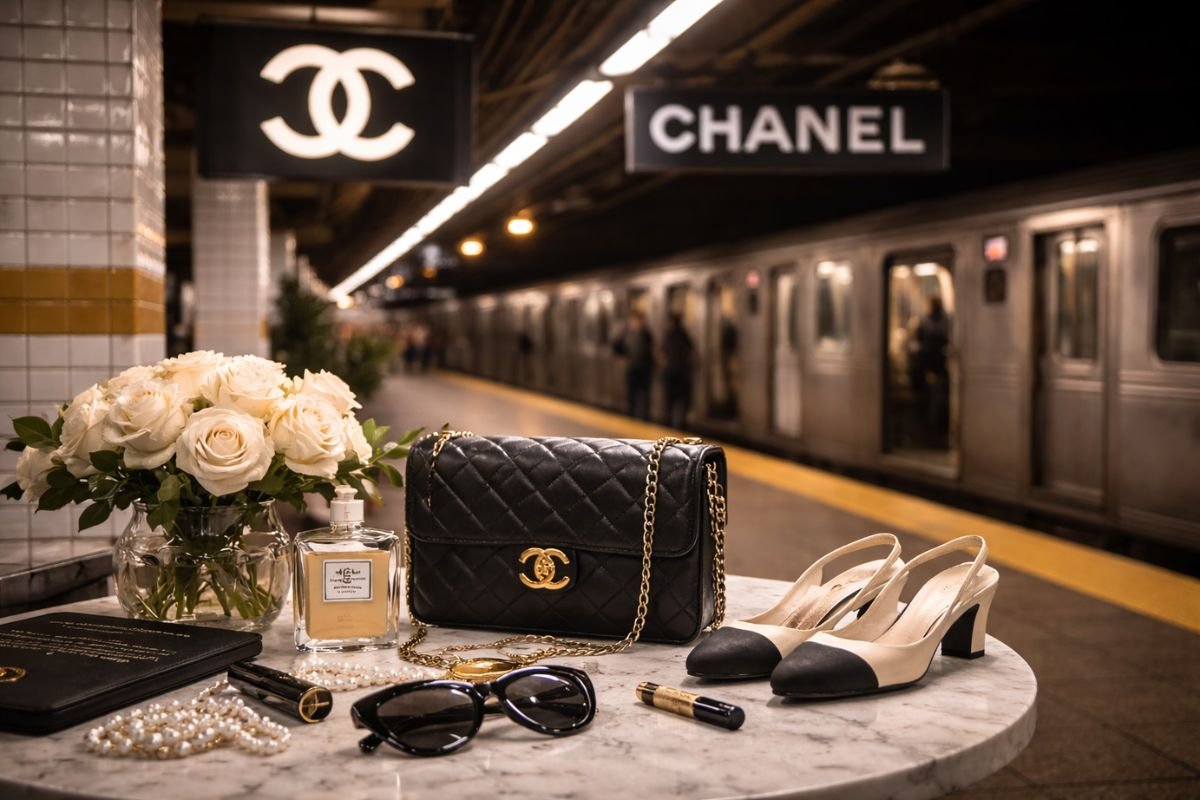
Matthieu Blazy, a highly talented new designer at Chanel, is giving this historic French fashion brand a renewed sense of urgency. With his runway show held at a New York City subway station, showcasing denim and featuring an Indian model with not one but two academic degrees, Blazy is pushing back against the elitism that has long been associated with the Chanel brand. That said, Chanel remains one of the most sought-after luxury labels in the world; it simply feels more compelling than ever.
The new face of Chanel is Bhavitha Mandava, a 25-year-old model from Hyderabad, India. Mandava holds degrees in architecture and media design and later pursued a master’s degree at New York University. Her original plan was to repay her student loans by working in the tech industry. Instead, she made headlines this month as the first Indian model to open a Chanel fashion show. Today, Mandava has become the new “It girl,” emblematic of Chanel’s evolving identity under Blazy’s direction.
View this post on Instagram
Historically, very few women have served as the defining faces of Chanel. Figures such as Vanessa Paradis, Claudia Schiffer, Kate Moss, and Cara Delevingne, while distinct in their own ways, shared a narrow aesthetic standard: white, extremely thin, very tall, and largely unattainable. This image echoed the classic European ideal embodied by Coco Chanel herself. Following Karl Lagerfeld’s death in 2019, the brand appeared to enter a stagnant phase, lacking a clear sense of renewed inspiration.
A New Vision for Chanel Under Matthieu Blazy
Founded by Gabrielle Chanel in 1910, the house has always been privately owned and remains under the control of the Wertheimer family. While sales surged in the post-pandemic period, 2024 marked a downturn. Revenue fell to $18.7 billion, and operating profit declined by approximately 30 percent. In response, Chanel turned to Matthieu Blazy, who had previously overseen a significant transformation at Bottega Veneta. His first major moment for Chanel, the Métiers d’Art Collection presented in New York in 2026, was met with strong acclaim.
Blazy staged the show in a disused subway station on Bowery Street in the Lower East Side, a location historically associated with counterculture and punk music. The setting reflected the message of inclusivity central to Blazy’s vision. “The subway belongs to everybody. Everybody uses the subway,” he explained. Once a symbol of the underground, the station provided a fitting backdrop for a version of Chanel positioned as accessible and contemporary rather than elite.
Models walked along the platform and through subway cars. They did not resemble the traditional Chanel stereotype of exclusivity and distance, but instead appeared as individuals drawn from everyday life, each reflecting distinct backgrounds and identities. The audience, which included Tilda Swinton, Kristen Stewart, and Chanel’s new ambassador A$AP Rocky, sat on wooden benches rather than velvet seats at the Palais.
Mandava, who had been discovered in a subway station the previous year, opened the Chanel show. Just two weeks after being scouted, she walked in Bottega Veneta’s Spring 2025 show. Shortly thereafter, Blazy announced his departure from Bottega Veneta and his move to Chanel, where Mandava soon followed. She has since become one of the most in-demand new models in the industry.
“I was approached on the subway on Atlantic Avenue,” she recalled in an interview with VIP. “They asked if I wanted to be a model. At first, I said no because I didn’t like models walking in high fashion shows,” she said, laughing. “Then he told me I could pay off my college debt with what I might earn, so I reconsidered.”
While many young women aspire to walk for brands like Bottega Veneta or Chanel, Mandava did not come from a fashion background. She grew up in a middle-class family in India with no exposure to high fashion.
“I didn’t know anything about it”, she admitted. “It was only after I returned to my classes that I realized how significant it was when classmates asked if I was the girl from Bottega Veneta.”
Mandava embodies the new attitude Blazy is introducing at Chanel: a definition of beauty that extends beyond traditional Western ideals, shaped by intellectual backgrounds and lived narratives rather than inherited privilege. Wearing denim paired with a camel-colored zip sweater, her look was understated enough that, outside the context of a Chanel show, it might have gone unnoticed. With a Chanel bag slung over her shoulder, she appeared as just another woman moving through the subway, part of a larger collective of models dressed in everything from eveningwear to city suits.
Blazy’s vision for Chanel is clear. It is no longer centered on preserving an untouchable image of French luxury. Instead, it presents a woman who is mobile, relaxed, intellectually curious, and oriented toward the future. Even for those who may never own a Chanel jacket or handbag, the brand now offers something aspirational through identification rather than distance. By introducing stories long absent from the house, Blazy has made Chanel feel relevant once again.