
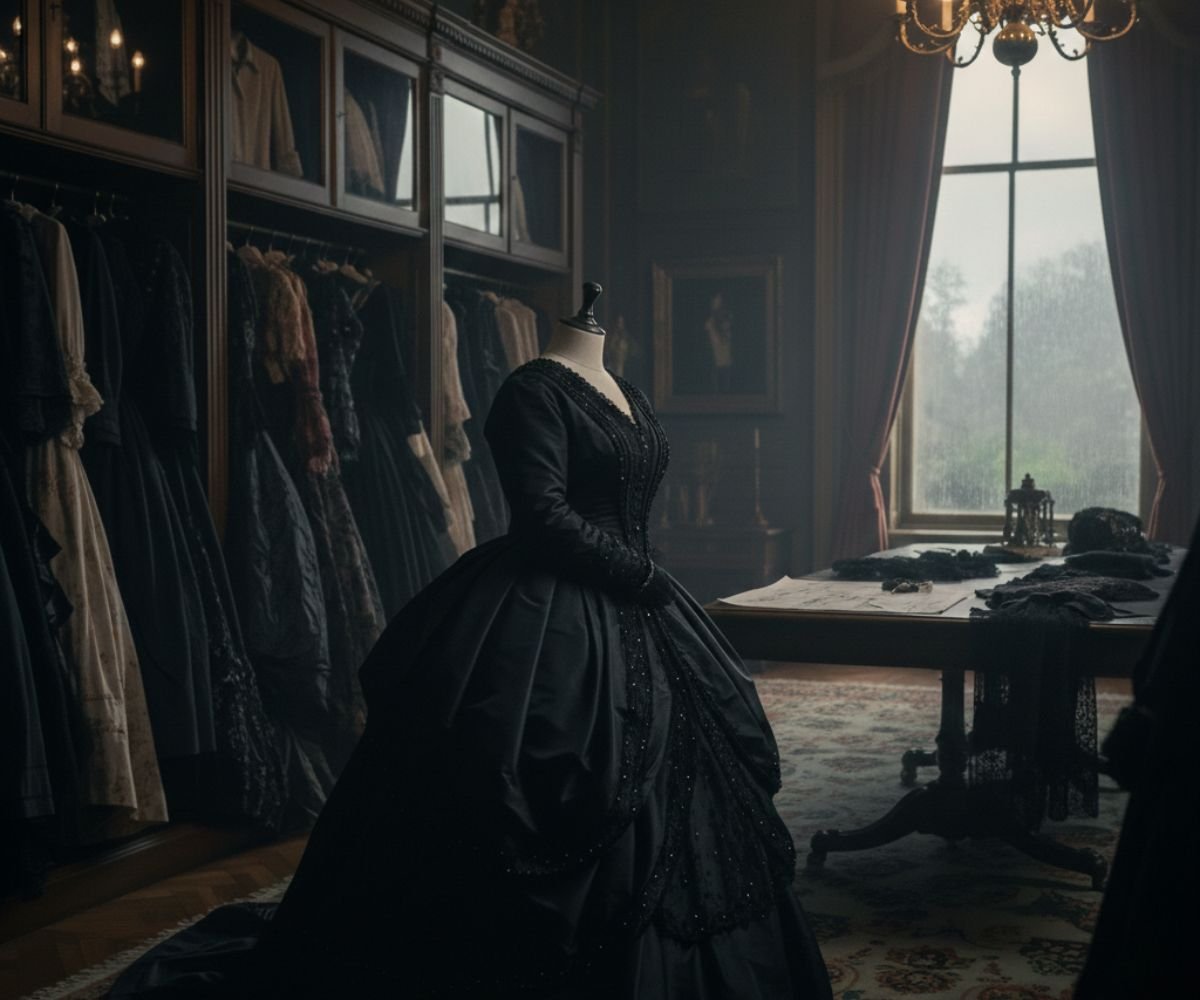
When considering mourning fashion within the Victorian era, it is easy to think of strict etiquette, black clothing, and social protocols that dictated how one should mourn. However, in the case of Queen Victoria, mourning fashion becomes more than just another fashion tradition. Instead, it becomes a way to view the life of an individual through the clothes she wore. Queen Victoria entered mourning following the death of Prince Albert in 1861 and remained associated with mourning dress for the remainder of her life. This prolonged period of mourning was not entirely foreign within Victorian culture, which defined mourning through strict stages. However, the extended adherence to mourning dress throughout Victoria’s life made her sartorial record rather unique.
View this post on Instagram
The garments associated with Queen Victoria’s later years demonstrate this sustained connection to mourning fashion. They are also distinctive in that they form part of a sequence of clothing worn by the same individual across decades. In her younger adulthood, Queen Victoria’s body type aligned more closely with mid-nineteenth-century fashion, characterized by a fuller silhouette. As she aged, her body changed, as described in historical accounts, and the clothing associated with her later life reflects this shift. The garments do not serve as commentary on her body, but rather as evidence of the passage of time, her health, and her aging.
Mourning dress itself also influenced what has endured. Black silk, crape, and other mourning fabrics were handled with special care, partly because of the rituals surrounding them and partly because garments associated with the monarch held symbolic importance. Consequently, more examples of Victoria’s mourning wear survive in major museum collections than everyday clothing from most people of the period. This creates an archive in which grief, royalty, and the body converge.
View this post on Instagram
Victorian mourning fashion was differentiated into stages. Deep mourning required matte black fabrics with minimal trim, while later stages allowed white or subdued detailing. The surviving dresses associated with Victoria illustrate these distinctions, marking changes not only in fabric and trim but also in the cadence of ritualized grief. They offer access to the language of mourning in textile form.
What makes this wardrobe significant is that it challenges abstraction. It reminds us that fashion history is as much the story of the bodies that wore the clothes as it is the story of the garments themselves or the designers who created them. Victoria’s mourning clothes bring this reality into physical form. They demonstrate clothing’s capacity to convey emotion while simultaneously recording the passage of years on a recognizable body.