
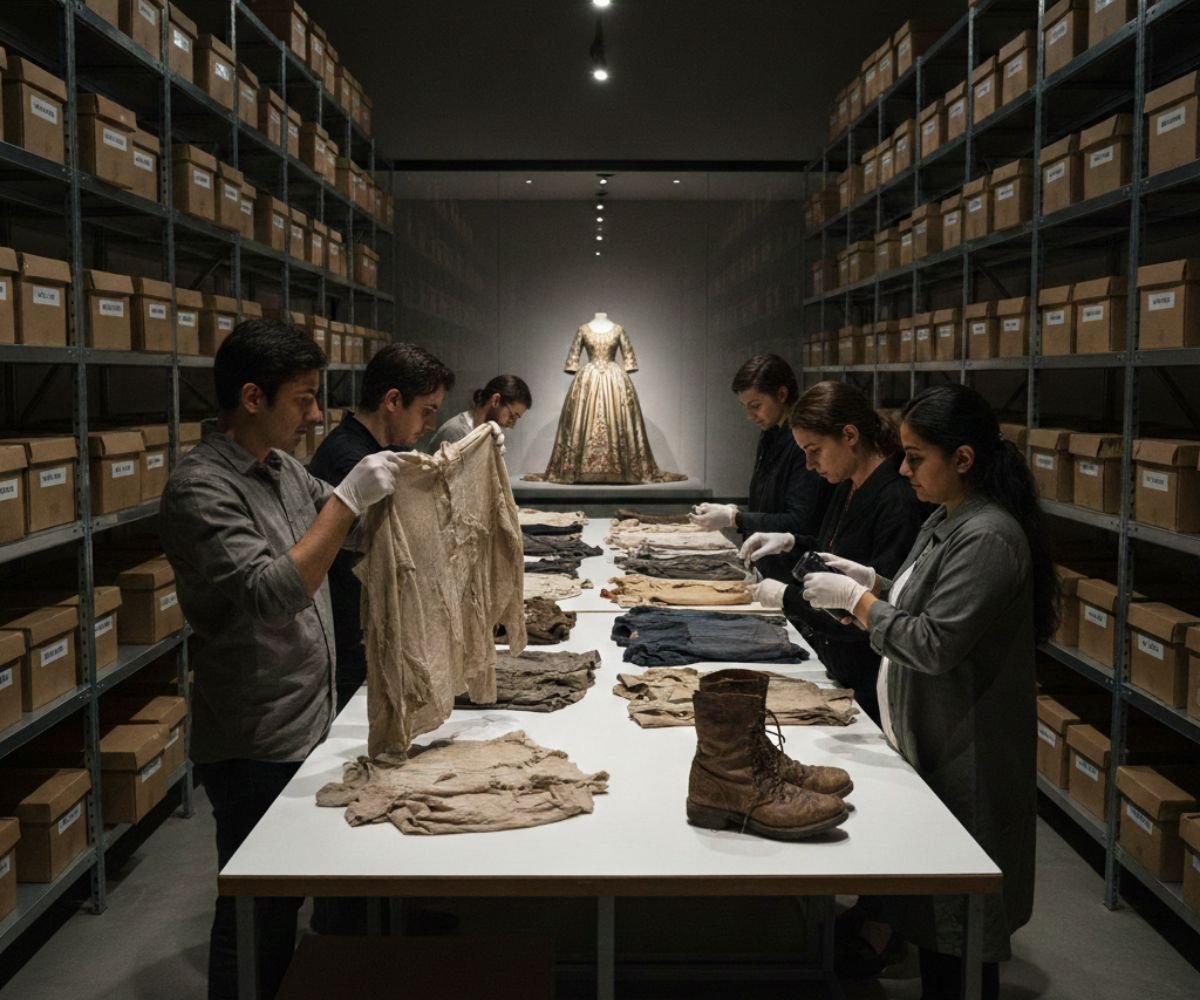
Walk into any fashion exhibition, and a familiar pattern emerges. There are dresses from royal courts and salons, dresses by famous designers, and dresses from famous lives. But invisible, or at least not readily apparent, is the clothing the vast majority of people wore. To understand why historical clothing is not preserved, it is necessary to look beyond fashion and into the material world.
Clothing, by its very nature, is not made to last forever. Fabrics wear out, seams break, and colors fade. Clothing for everyday wear is used, washed, repaired, and repurposed until it can no longer be used. Unlike special occasion clothing, which may be used sparingly, everyday clothing is subject to constant friction. As a result, over time, there is little or nothing left to preserve.
Another factor is the role of economics. Until relatively recently, textiles were luxury items. When a garment wore out, it was not discarded. Instead, its fabric was repurposed into children’s clothing, household linens, or cleaning rags. Buttons, trim, and closures were salvaged for reuse. In this process, the life of a garment was not determined by fashion, but by the ability of its fabric to be repurposed. By the time a garment was no longer useful, little or nothing remained of its original form.
Finally, there is the role of storage. Special occasion clothing, by its nature, is more likely to be stored, handled, and remembered. Clothing for everyday wear, on the other hand, was passed from hand to hand without much fanfare. Without a compelling story or memory, it was unlikely to be saved by families, donated to museums, or recognized for its historical significance.
This imbalance has been perpetuated in the collecting practices of fashion history museums, where value has long been tied to innovation and celebrity. As explored in discussions around who decides what fashion history looks like, everyday garments – anonymous, practical, and often worn by marginalized groups, have been overlooked not because they lacked significance, but because they didn’t fit the traditional mold of what was considered “worthy” of preservation.
View this post on Instagram
Material culture studies have highlighted the significance of the everyday in understanding the past, arguing that ordinary objects can reveal as much as exceptional ones. For instance, the cut of a work dress, the patch on a sleeve, or the choice of a durable fabric can provide important insight. Yet it is precisely this evidence of wear that also makes clothing preservation challenging.
The loss of everyday clothing also shapes how we perceive the past. Without evidence of daily wear, history appears more formal, more elegant, and more uniform than it actually was. We see the best clothing, the rare clothing, the symbolic clothing, and assume that this represents the past as a whole. In reality, most people wore clothing designed for function rather than display.
Digital documentation and new collecting strategies are helping to address this issue. Some museums are actively seeking contemporary everyday garments in order to prevent a similar loss in the future. Nevertheless, the historical record will always bear the imprint of what was worn out, used, and ultimately erased.
In asking the question “why does historical clothing disappear,” we begin to understand that the process of disappearance itself is part of fashion history. What remains speaks to one kind of history. What did not remain speaks to another, one that involves work, ingenuity, and the ways the material world was lived.