
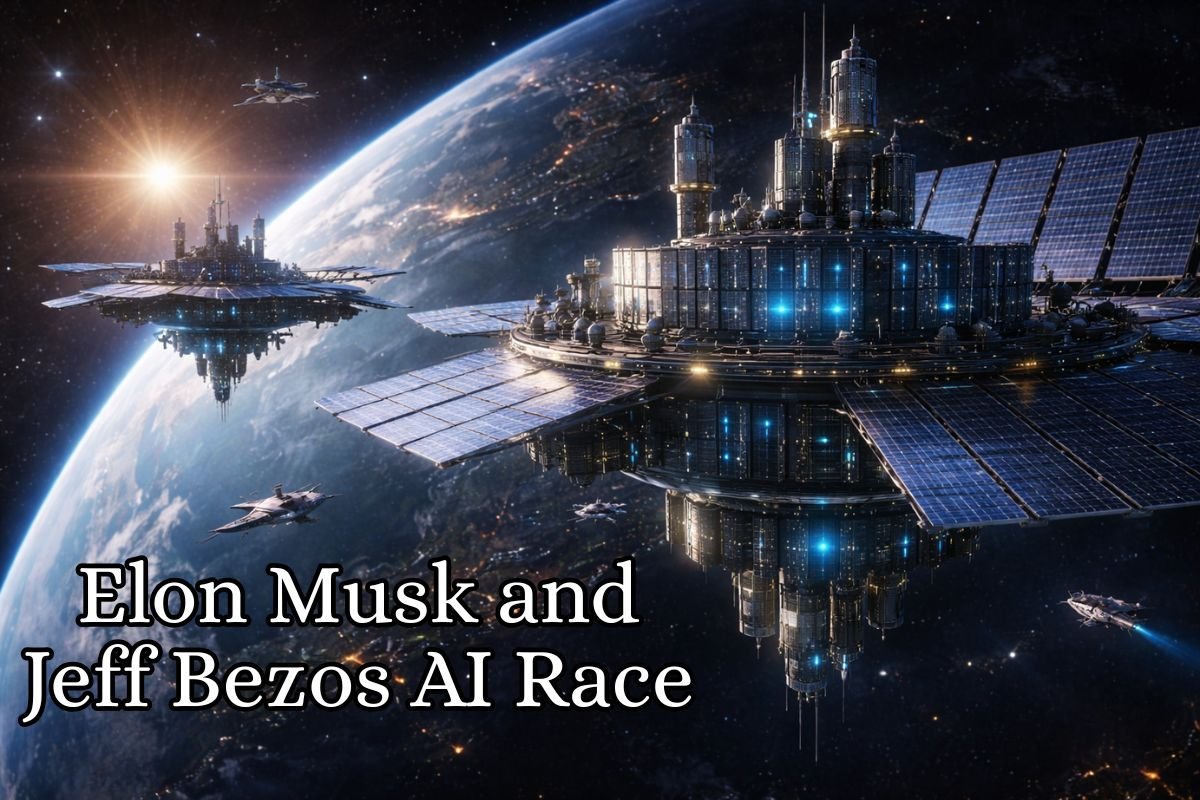
Space has always been a battle zone for visionaries and giants, but the ongoing battle between Elon Musk and Jeff Bezos is like none other that has existed before. These two billionaires, who have already transformed the space world, are planning to conquer a new frontier: space-based data centres. This is set to redefine how we view artificial intelligence, computing, and energy production.
Blue Origin, owned by Jeff Bezos, has been working for the past year on solutions to build data centers in orbit around the planet for the sole purpose of training advanced artificial intelligence. Meanwhile, Musk is working on using new Starlink satellites to create what amounts to a distributed computing network that will essentially create data centers in space. It’s not just a question of which entity will get there first, but whether any of this can actually work, especially as Bezos continues to expand his influence in industries far beyond aerospace, including recent moves in media.
Why Send Computers to Space?
At face value, this does look ridiculous. Why take something that works so well in one environment and move it to space, where accessing it is so costly and difficult? The key to this is a problem with modern data centers: energy. Modern data centers, specifically those utilizing sophisticated models involving AI, use vast quantities of electricity. Simply training one AI can take as much electricity as a few towns together consume for several months. Computers use a vast amount of electricity because they produce a lot of heat.
In space, of course, the energy requirements are entirely different. The sun is practically shining all the time, so there is no shortage of solar energy. Cooling systems are unnecessary because dissipation of heat to cold space is easy. In addition, data centers like server farms that require a lot of resources on Earth would no longer be needed if constructed in space. It all sounds too good to be true, but making all this a reality has its set of challenges.
Making the Dream a Reality: Technological & Logistical Issues
To ensure that the computing power of such a system is comparable to that of a massive data center on Earth, which scales to gigawatts, a network of thousands of satellites in orbit would be required, which could handle computing power of tens to hundreds of kilowatts. Besides the difficulties of the satellites’ launch, the system would have to employ an incredibly complex network with record-high demands for design and operational safety. Each of the satellites would have to be able to work effectively in high radiation, extreme temperatures, and space dust conditions while supporting high-speed data transfer to Earth and between the satellites.
The companies leading the new space race
Blue Origin is working on developing advanced satellites with very powerful processors, massive solar power, and a laser-based communications system with the ability to transmit data at a speed comparable to Earth-based data centers. Blue Origin is also exploring the possibility of improving the satellites in orbit, possibly with the use of robots or autonomous orbiting servicing satellites.
SpaceX is working on using its current Starlink satellite system, with plans to enhance the current satellites or introduce a new set with the sole purpose of being used for AI computations, utilizing the existing massive network for computing purposes. This innovative use of infrastructure reflects the company’s broader push for advancement, subtly echoing its technological leaps in other domains of aerospace development.
However, technology alone cannot be the solution. Maintaining technology in space is one of the greatest challenges. This is because, in space, if a server goes down, a person has to travel to repair it. In space, it is a lot more complicated. This is because a server should be equipped with the ability to be maintained by a backup system or remotely. A single error in one of these satellites might make a multimillion-dollar tool worthless.
Communication and Security: The Main Concerns
Another area that has to be considered is that of communication. In order to be useful and relevant to ground users, a space data center requires it to be connection through fast and uninterrupted data transmission. This requires huge ground-based infrastructure and antenna technology. A delay of millisecond accuracy could be pivotal when it comes to AI models.
But even if all that was sorted out, there are many other challenging issues that still need to be addressed. To begin with, there’s the issue of data protection and privacy. Satellites could be an enticing source for hackers, governments, and terrorists. “So how would an attacker encrypt their data in order to transmit it via a satellite without having their transmissions decrypted by the satellite itself? Furthermore, what if an attacker were somehow able to gain access to their satellite? What would happen if someone could hack into the communication between their computer and satellite?”
Recent research shows that current AI might be transforming the cybersecurity arena. For instance, an AI robot named Artemis, created at Stanford University, was able to differentiate weaknesses in network systems in a way that surpassed human hackers. But Artemis was not perfect, sometimes making errors and overlooking some gaps. The question is whether all issues in a space-based data center concerning security can be solved through AI.
Further, regulation is an important point to consider. In which country does the responsibility lie for an orbiting data center? In the country that launched the satellite? In the for-profit organization that manages the orbiting data center? But also, what if the data of the people of one country is kept at an orbiting facility owned by an organization that is located in another country? Such questions are political questions that have yet to be addressed. These may be the greatest challenges to implementing this technology.
What This Means for the AI Industry
But if we are able to achieve the point where space-based data centers are possible, the implications for the AI industry are enormous. To start with, one of the biggest problems with AI will be solved once and for all, at least when it comes to energy consumption. It now takes an energy budget capable of rivaling the GDP of some small countries to maintain an AI system, and big corporations are having difficulty finding space to accommodate the power needs. Energy in space will be essentially free and plentiful.
Second, it will allow us to achieve a major leap in computing abilities. The models of artificial intelligence would then be able to incorporate far more complex ideas, and the training process would take place much quickly. This would ensure that we are able to create more advanced artificial intelligence for solving more complex problems, whether it is medical research or the planning of a smart city.
Third, space data centers might mitigate the negative impact made by the AI sector on the planet. For instance, data centers on Earth cause air pollution, use water in the process of cooling, as well as consume a lot of land. In space, all these challenges will be eliminated. It might be a remedy that works for both technology and planet Earth.
The Risks and Challenges Ahead
It is clear, however, that there are also some dangers associated with this new concept. Data centers in space mean that we rely on technologies over which we do not have complete control. And if something fails, whether it is a technical glitch, an attack, or a geopolitical dispute, this may disrupt essential services. And what if these new data centers are being run by a few private corporations? Fortunately, the challenges that come with the technology, the economy, laws, and strategies are huge, but the potential is just as huge. We only need to navigate through the challenges and make the dream of the time when the data centers are hovering above us come true.
We could find the energy being cleaner, the computer being more powerful, and the possibilities being endless. But in the event that we fail, then a lot of resources shall be allocated to a dream that shall never come to reality. We shall be left with the space debris and economic debt. We can still remember the time when we accessed the internet. We shall be connected to the internet via the satellites that run solely on solar energy. Or maybe we shall realize that the dream shall forever remain just that just a dream.