
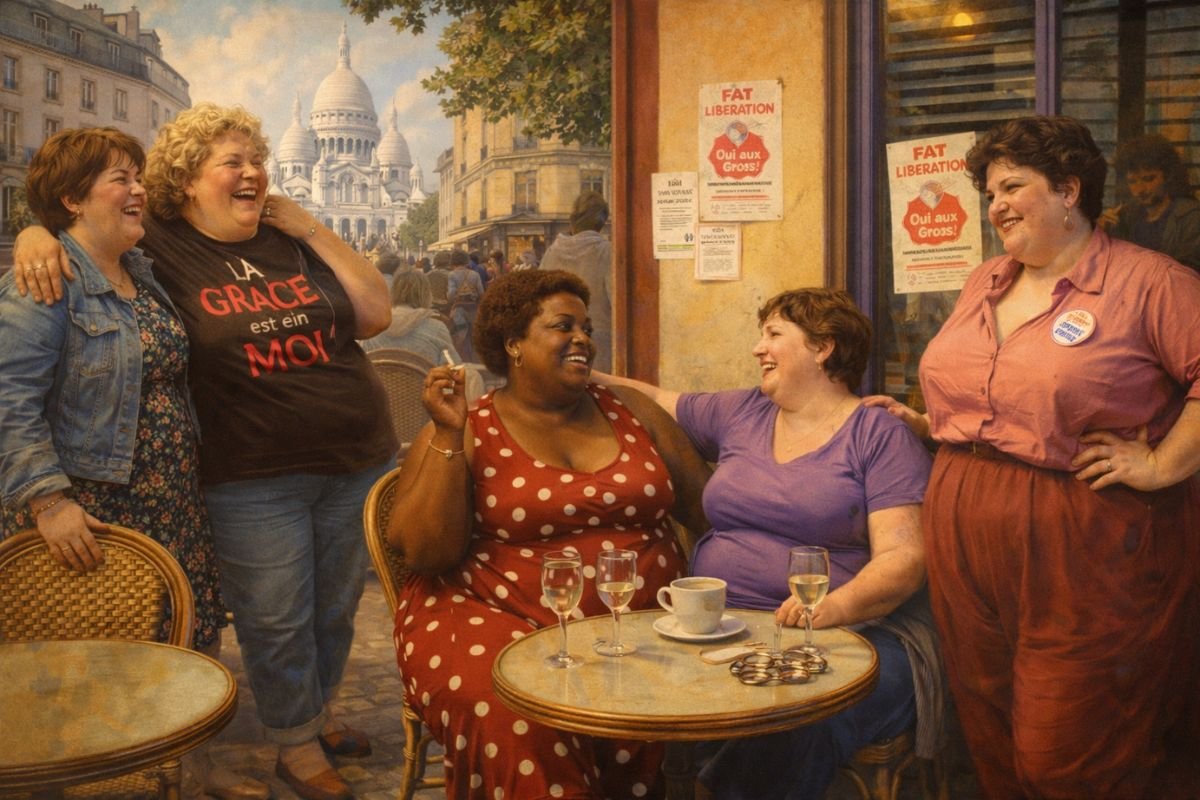
The story of the Fat Acceptance Movement Paris 1980s shows how the issues of body image and body visibility have been a concern long before the body positive movement came to global attention. During the late twentieth century, a small group of people in Paris started creating a space where those whose body image did not conform to dominant beauty expectations shaped by beauty ideals of the past could meet, socialize, and feel visible.
The most interesting place associated with the Fat Acceptance Movement Paris 1980s is the nightclub called Club Allegro Fortissimo. This nightclub is associated with the French advocacy group of the same name.
View this post on Instagram
The Fat Acceptance Movement Paris 1980s and Its Origins
The Fat Acceptance Movement Paris 1980s is not an isolated event. The fat acceptance movement started to gain momentum in the United States during the late 1960s. During this period, activists started to fight against the discrimination of people on the basis of their weight.
By the 1980s, the issues of body image stigmatization started to reach the European mainland. During this period, the French advocacy group called Allegro Fortissimo started to emerge as one of the earliest groups to raise the issues of body image stigmatization. This group started to promote the issues of weight discrimination.
The Fat Acceptance Movement Paris 1980s was a small movement. However, the movement helped to create a social network where people rarely saw themselves being represented.
Club Allegro Fortissimo and the Paris Nightlife Scene
Within the context of the Fat Acceptance Movement Paris 1980s, the nightclub called Club Allegro Fortissimo became one of the most interesting places in the Paris nightlife scene. The club, located near Place de Clichy, welcomed women whose body size exceeded conventional beauty standards an early example of the cultural tensions around body image that would later appear in debates around body image legislation.
At a period when many nightclubs espoused a rather narrow definition of glamour and thinness, the club provided a space where individuals of different body types could participate in the nightlife scene without feeling alienated from the group.
The interior of the club was reminiscent of a typical Paris nightclub. There was music playing late into the night, people dancing together, and sometimes performances that formed part of the night’s program.
Some parts of the club featured a bath area that formed a socializing area for the patrons during the night.
William Klein’s Photographs of the Club
One of the most important visual records pertaining to the Fat Acceptance Movement Paris 1980s is that by the famous American photographer William Klein. Famous for his work on documenting the unconventional, Klein took pictures at the club in 1990.
The photographs taken by Klein capture the essence of the club. The pictures depict patrons posing for the camera, smiling, and relaxing in the bath area or the lounge area.
The documentary style of the photographs by William Klein provided a rather unique opportunity for the viewer to get a glimpse into a unique social scene that was never depicted in the media during that period.
A Social Space in a Changing Cultural Conversation
The existence of a club like Club Allegro Fortissimo demonstrates that the Fat Acceptance Movement Paris 1980s provided a platform for individuals to come together around a subject that had not yet been widely discussed in the media on a global platform.
Although the movement was relatively small in comparison to other social movements, it also worked to break down the idea that only a specific type of body was suited for nightlife and fashion culture. The club provided a space for people who felt marginalized in other social spheres to meet and socialize in a way that celebrated a different type of body visibility in Paris.