
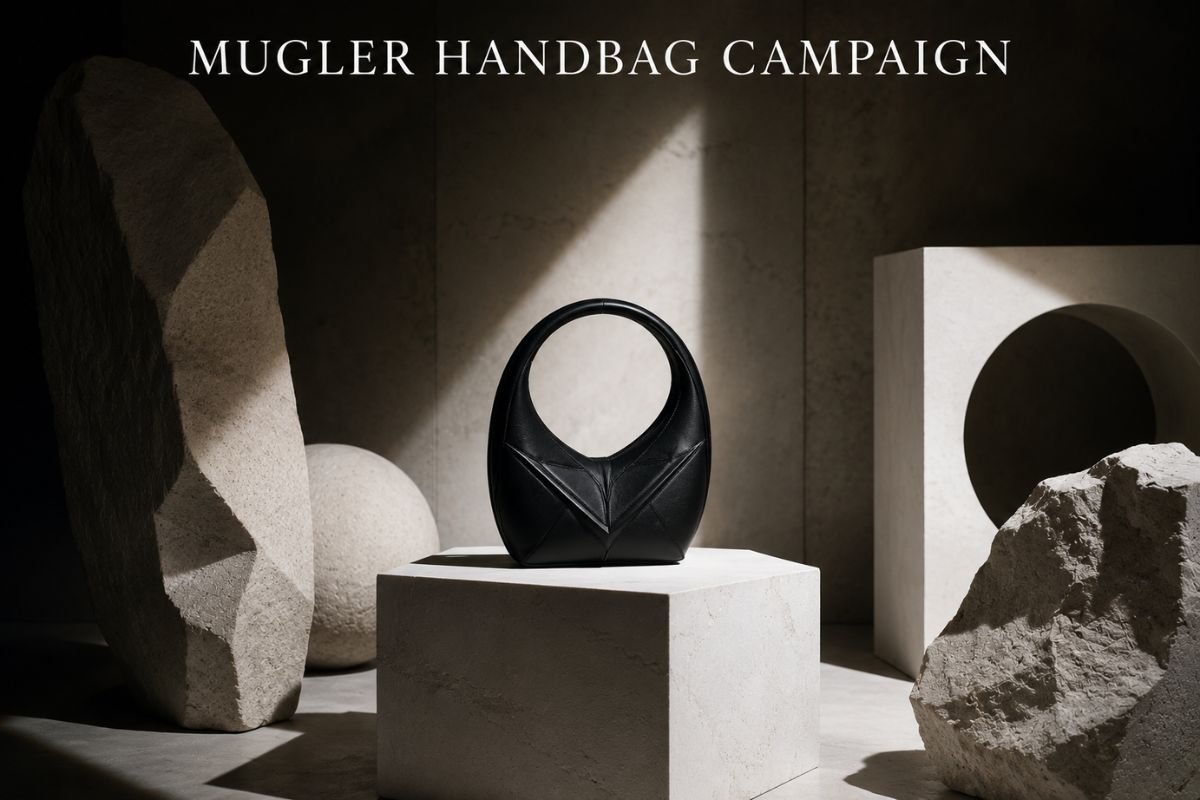
Mugler has chosen an unconventional face for its first dedicated handbag campaign under creative director Miguel Castro Freitas: French bodybuilder Tatiana Horslaville. Photographed by Chris Lensz, she appears in a series of black-and-white portraits where her muscular physique shares the frame with the house’s new Aurora and Lua handbags.
The images are striking for their simplicity. With little to distract from Horslaville’s sculpted form, the curves and structured lines of the bags become easier to appreciate. It is an unexpected introduction to Mugler’s latest leather goods, although the celebration of powerful bodies has been part of the house’s identity since the days of its founder, Manfred Thierry Mugler.
There is also a personal story behind the accessories themselves. Aurora takes its name from Castro Freitas’ mother and revisits a handbag design from Mugler’s Spring 2002 collection, while Lua, named after the Portuguese word for moon, introduces a softer crescent-shaped silhouette.
View this post on Instagram
Two Handbags With Very Different Personalities
Aurora draws from a relatively obscure piece in Mugler’s archives, originally presented in the Spring/Summer 2002 Franges et clous collection and photographed by Helmut Newton.
Castro Freitas has updated the design with a molded exterior, a raw-edged interior, and distinctive metallic hardware known as the monolith. Made in Italy, the bag comes in black, taupe, and a python-effect finish that recreates the appearance of snakeskin without using exotic leather.
Lua takes a different approach. Its curved shape follows the outline of a crescent moon, with a structured exterior and a softer leather interior. Available as a shoulder bag and a larger city bag, it offers a more fluid alternative to Aurora’s defined construction.
Both designs demonstrate how the house’s interest in dramatic shapes can translate into accessories intended for everyday use.
The Artistic History Behind Mugler’s Campaign
The decision to cast Horslaville becomes more interesting when viewed through Mugler’s history.
Manfred Thierry Mugler frequently explored exaggerated proportions, athletic physiques, and theatrical presentations. His runway shows brought together models, performers, and unconventional figures whose presence was often as memorable as the clothing.
In the new campaign, Horslaville’s muscular definition creates a visual relationship with the handbags’ architectural forms. The photographs draw on traditions of portraiture and sculpture, with the human figure occupying much of the composition.
The imagery also recalls Robert Mapplethorpe’s portraits of bodybuilder Lisa Lyon, photographed during the early 1980s. Those portraits explored the appearance of muscularity through carefully controlled lighting and poses. The resemblance offers an interesting artistic reference for Mugler’s choice of subject, although it should not be taken as confirmation that the campaign directly recreates Mapplethorpe’s work.
The result feels connected to the house’s theatrical history without requiring an elaborate set or dramatic styling.
Why Aurora and Lua Matter for Mugler
Castro Freitas became Mugler’s creative director in 2025, succeeding Casey Cadwallader. His first handbag designs introduce another category through which he can develop the house’s identity beyond runway clothing.
Accessories offer designers a different creative challenge. A garment can use movement, draping, and the proportions of the person wearing it, while a handbag must maintain its character as an object with a practical purpose.
Aurora and Lua approach that challenge through their construction. The former emphasizes a firm, recognizable outline, while the latter explores a softer curve. Their shared metallic details help establish a connection between the two designs.
For shoppers exploring Mugler’s wider range of seasonal collections, the handbags introduce accessories that carry recognizable elements of the house’s design language.
The campaign also suggests a more restrained visual direction than some of the celebrity-driven productions associated with Mugler in recent years. That does not necessarily signal the end of the house’s theatrical side, but it gives these particular designs room to attract attention through their shapes.
A New Chapter for Mugler Leather Goods
The Aurora and Lua launch gives Castro Freitas an opportunity to revisit Mugler’s archives while introducing accessories of his own.
Aurora carries a direct connection to a design from 2002, whereas Lua brings a new silhouette into the collection. The two bags offer different interpretations of the house’s architectural approach without relying on identical shapes.
Horslaville’s portraits add a distinctive identity to their debut, one that feels appropriate for a fashion house with such a long history of experimenting with the human figure.
Whether Aurora and Lua become enduring signatures for Mugler will depend on how the designs develop beyond their first campaign. For now, they offer an intriguing look at how Castro Freitas is approaching the house’s accessories, with enough personality in the objects themselves to hold the viewer’s attention.