
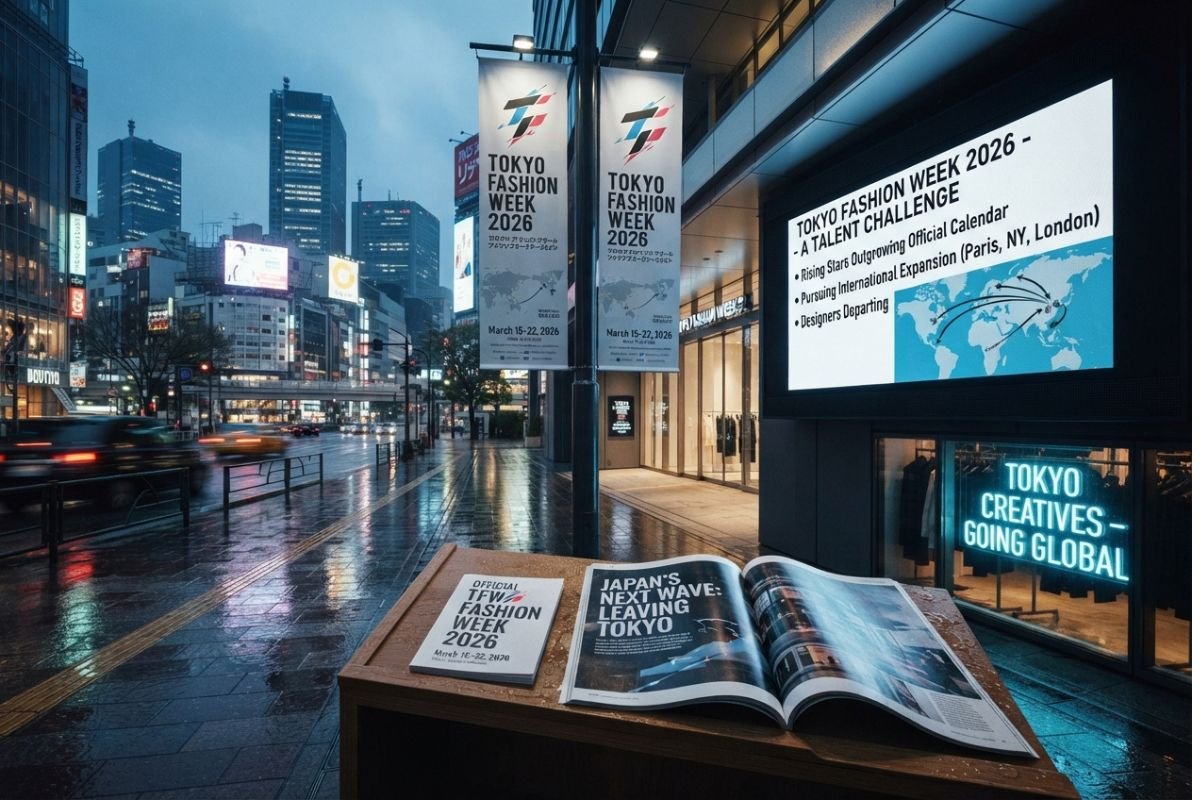
One of the peculiarities of Tokyo Fashion Week 2026 is that some of its former discoveries have started to require a new approach due to their ambition. Those brands decided to show earlier, build international wholesale networks, consider Paris or Milan or believe that a runway during fashion week is not what they need anymore. Therefore, the talent drain is partially caused by Tokyo Fashion Week getting better at producing designers that will outgrow the official calendar.
It became especially noticeable in 2026.
Fetico, Pillings, Kamiya and Keisuke Yoshida were among the recognized local designers that presented outside the official Fall 2026 schedule. As a result, the official Tokyo Fashion Week 2027 (August 31 – September 5) showed 27 collections; however, some recognizable local names were absent from it.
It seems to be obvious that Tokyo lost some of its designers. Nevertheless, the key thing here is to understand why they are leaving.
View this post on Instagram
Success Changes the Requirements
For a relatively new label, fashion week solves the problem of visibility.
Being presented on a runway, a designer gets the opportunity to appear in front of journalists, buyers and others involved in fashion. Moreover, awards and special programs give access to this ecosystem. Tokyo Fashion Week does the same job and helps newcomers to get there.
However, the priorities of a brand change as it develops.
Pillings is a perfect example of this phenomenon. Designer Ryota Murakami moved his Fall 2026 show earlier as production timing became hard for him. In addition, the label, which was initially selling only domestically, was also presenting in Dover Street Market London. International delivery requires earlier completion of the collection. Thus, by Spring 2027, Pillings returned to Tokyo’s official schedule, but Murakami was already planning to present on a bigger scale.
View this post on Instagram
This is definitely not the case when a designer leaves fashion week as there is nothing interesting to do there. This is an example of a business whose priorities change.
The Fashion Week Is a Business Decision
The runways may seem to be rather cultural from an outsider’s perspective. However, the backstage of fashion weeks is far less romantic, there is a business with production deadlines, factory capacities, wholesale appointments and buying budgets.
Japanese designers faced this reality.
Those who decide to stay on the official dates of Tokyo Fashion Week will find themselves presenting their creations after international buyers have spent a part of their budget in other fashion capitals. Showing earlier gives a designer the opportunity to sell domestically and travel for international wholesale.
Production is another factor. As designers describe the increased competition for skilled factories and fabric producers in Japan, showing earlier provides additional time for production.
Thus, the absence from the official fashion week does not mean that a designer denies the event. It is just about the date that is more beneficial.
And as soon as it becomes clear, the talent problem in Tokyo gets a new dimension.
Tokyo Builds Brands Faster than It Can Contain Them
Fetico founder Emi Funayama had almost 60 Japanese stockists by early 2026, and she was planning to expand further. Harunobu Murata, whose business was growing at 50% yearly, moved his presentation earlier and considered the possibility of presenting in Milan or Paris in the future. Keisuke Yoshida worked on expanding wholesale, opening his first store and gaining stockists in other countries.
All of these designers are at different stages, but the pressure influencing their decisions is the same.
A designer needs to be noticed in Tokyo and later needs access to the world outside Tokyo.
This leads to a very hard question for any fashion week which aims to discover talented designers: if it succeeds in doing so, should it hope that the designer will not leave?
Perhaps not.
Maybe, the true test is whether the new generation is ready to occupy the place of the old one.
Tokyo Fashion Week Is Already Adjusting to That Change
JFWO began adjusting in a way that indicates an understanding that the issue is more complicated than attendance on one official calendar.
In early 2026, the organization began helping designers showing outside the official schedule with press and buyer contacts. Although the organization considered these measures temporary, its idea is crucial: the support of Japanese fashion does not mean that all designers must show during the same week.
By the Spring 2027 season, this idea changed a little. JFWO began defining itself as a platform that provides different presentation formats and strengthens international exchange. Also, Tokyo expanded its calendar, allowing the participation of non-Japanese designers. Nine international participants were among 27 collections shown in the season.
Thus, the nature of the event changes.
Tokyo Fashion Week does not necessarily need to compete with Paris by making every successful Japanese designer present there forever. Tokyo can become more valuable as a platform of mutual movement: discovering Japanese designers before their international expansion and attracting international designers to a domestic market with distinctive characteristics.
The True Signal of Tokyo Fashion Week 2026
It is still dangerous. If the fashion week keeps losing its recognized designers, it will decrease its attractiveness for international buyers, editors and media. Emerging designers benefit from showing near brands that already exist. When the anchors disappear, it becomes harder to promote the platform.
However, preventing successful designers from leaving would only help to hide the problem.
The more important task of Tokyo Fashion Week may be the creation of a system in which leaving the official calendar does not mean leaving the Tokyo fashion ecosystem.
To solve it, Tokyo needs to be more flexible in showing dates, have more contacts with international buyers, help brands even after their graduation from the emerging category and have a steady pipeline of young talent.
The Spring 2027 season gave evidence of both sides of this equation. Established designers began reconsidering how they use Tokyo Fashion Week while new participants and international labels appeared on the calendar. JFWO even refused to name the winner of the 2027 JFW Next Brand Award Grand Prix, believing that the finalists were not prepared enough to sustain a show, and decided to reconsider how this award should work.
This decision made the situation particularly evident.
Tokyo Fashion Week 2026 is not just trying to replace designers who left. It is forced to reconsider the way it operates between the discovery of talent and the international viability of this talent.
If Tokyo Fashion Week continues to produce designers that will outgrow the official calendar, their departure will not necessarily indicate failure.
The more important question is whether Tokyo will continue to produce the designers who leave next.