
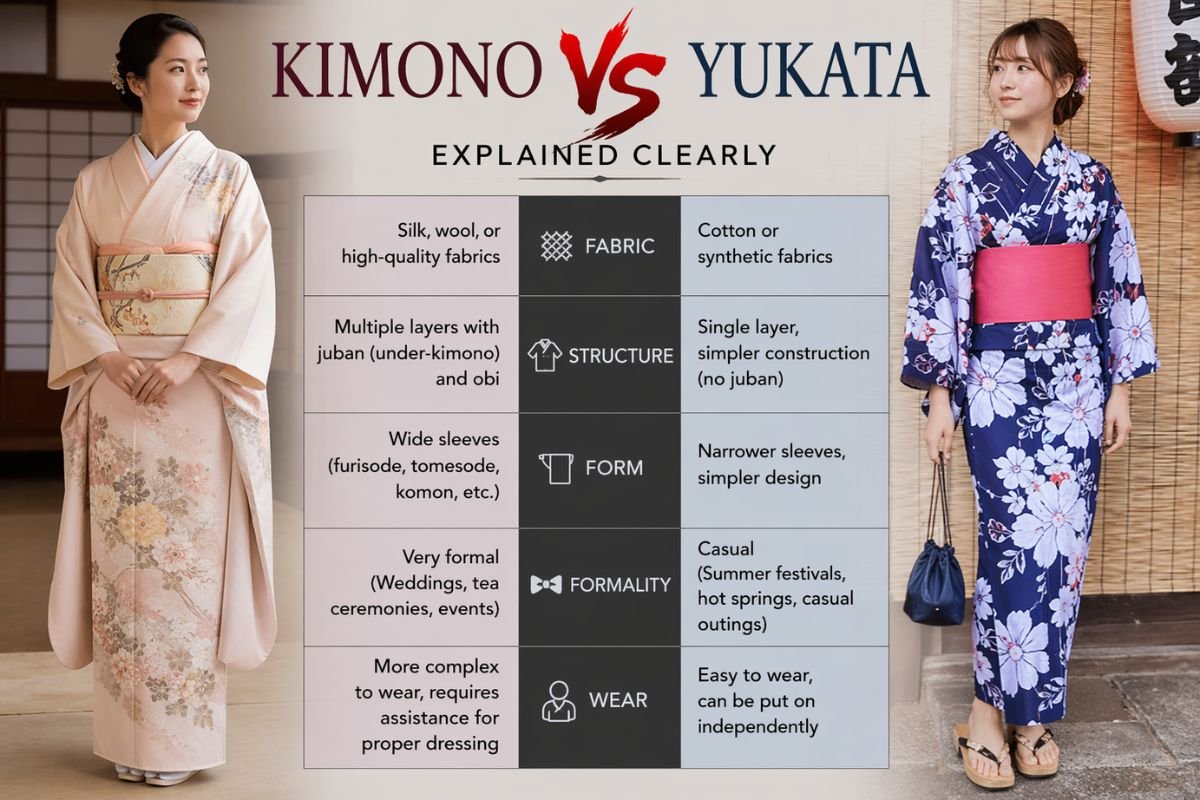
When trying to figure out what distinguishes a kimono from a yukata, one should think about such aspects as the level of formality, the fabric used to create a garment, its structure, and the circumstances when it could be used.
Fabric and Materials Used
First and foremost, the type of fabric matters when comparing kimono and yukata. A kimono is most likely made of such materials as silk and others. Such a fabric ensures that the garment has some weight and is able to hold a shape.
A yukata, in turn, is made of natural, breathable materials. The most common ones include cotton and linen. Such materials help make the garment lighter and comfortable to wear.
Structure and Layering
When looking at the garments’ structure and their layering, it will become clear how a kimono differs from a yukata. In terms of construction, a kimono is usually worn in several layers. Underwear and other components have to be added to achieve the desired effect.
The layering of a kimono is what makes it so complex and special. It is not possible to achieve the same look if one does not follow certain rules of wearing it. On the contrary, wearing a yukata requires no additional effort in terms of layering.
Formality and Wearability
Another important aspect is the difference between the types of occasions when these garments are used. A kimono is usually considered to be a formal dress code item, meaning that it is supposed to be worn to a formal event or a ceremony.
Conversely, yukatas belong to the category of garments people wear during informal, casual occasions. As a rule, they are used in a hot season. That is why this aspect of the kimono vs yukata comparison should be noted.
Difference in Weight and Wear Comfort
When comparing kimono and yukata in terms of comfort, one can say that wearing a kimono feels heavy and uncomfortable compared to wearing a yukata, which influences how they are worn today. The reasons for this are obvious as far as the material used to manufacture these garments is concerned.
While wearing a kimono, the person’s movements will be restricted by the fabric and its weight. At the same time, it is not difficult to notice how freely and easily a yukata can be worn. It seems as if it does not even exist!
Visual Effect Produced
When comparing a kimono and a yukata in terms of their visual appearance, it would be reasonable to claim that these garments are different in appearance too. It is caused by the fact that kimono is layered and made of more complex materials.
A yukata, in turn, does not have layers and is lighter. The patterns, which can be found on it, may not be as complicated as those that appear on a kimono. However, a yukata has its own peculiarities.
Seasonality – Kimono vs Yukata
The season when these garments are worn matters a lot too. When choosing to wear a kimono, people usually consider the fabric used to manufacture it in order to find out whether they can use it in the summer season too.
A yukata, however, has to be used only in warm weather conditions due to its construction and fabric. These two factors contribute greatly to the creation of a comfortable environment when the temperature is high.
Wearing Experience
Finally, the difference in the wearing experience should be taken into account. Wearing a kimono involves a special technique because its structure and design require it. One needs to pay attention to posture while wearing a kimono.
When wearing a yukata, such attention to details is unnecessary as there are no restrictions related to movement and posture while wearing it.