
The enormous pink flowers decorating Demi Moore’s black velvet gown at the 2024 Met Gala had an unusual origin. They came from wallpaper. Designer Harris Reed had incorporated leftover decorative material into a dramatic evening dress, giving something originally intended for interiors an entirely different life.
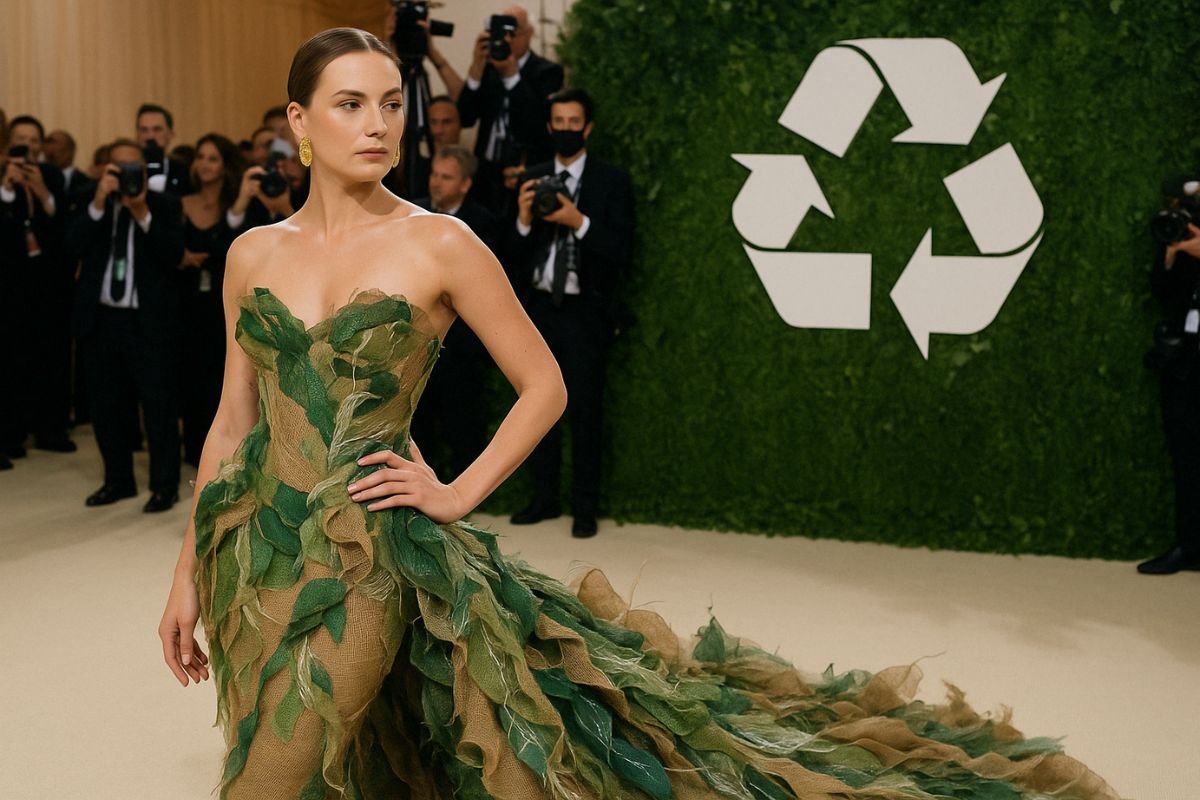
Moore’s gown was one of several memorable examples of sustainable fashion at the Met Gala, where designers have explored everything from recycled plastic fibers to antique textiles and archival couture.
Each approach tells a different story about how luxury clothing can be created, preserved, or worn again. And while a spectacular red carpet appearance doesn’t necessarily make a garment environmentally sustainable, the ingenuity behind some of these designs offers an interesting look at what fashion can do with materials that already exist.
הצגת פוסט זה באינסטגרם
Emma Watson’s Dress Was Designed to Be Worn Again
Back in 2016, Emma Watson arrived at the Met Gala in a monochrome Calvin Klein ensemble created in collaboration with Eco-Age as part of the Green Carpet Challenge.
The combination of a fitted bustier, tailored black trousers, and a sweeping train concealed an interesting production story. Several of the fabrics were woven using yarn derived from recycled plastic bottles, while other components incorporated organic cotton, organic silk, and recycled materials.
Perhaps the cleverest feature, however, was the construction of the outfit itself.
Rather than creating a single gown that would be difficult to wear on another occasion, the design team developed separates. Watson could pair the trousers with a different top, incorporate the bustier into another evening look, or save the detachable train for a future red carpet appearance.
The design considered what might happen to the clothes after the photographs had been taken, an important aspect of fashion sustainability that goes beyond the choice of fabric.
Four Unusual Materials That Found Their Way Onto the Red Carpet
The 2024 Met Gala, accompanying the Costume Institute’s exhibition Sleeping Beauties: Reawakening Fashion, provided a particularly interesting opportunity for designers to experiment with existing materials.
For Demi Moore’s gown, Harris Reed sourced vintage wallpaper from decorative wallcovering specialist Fromental. Its embroidered flowers became part of a sculptural silhouette that appeared to bloom around Moore’s body, with pointed structures rising behind her shoulders.
Meanwhile, Chloë Sevigny wore a creation by designer Dilara Fındıkoğlu constructed from Victorian gowns. The antique fabrics brought genuine historical character to an outfit created for a contemporary fashion event.
Charli XCX took a completely different direction in a custom Marni gown fashioned from old T-shirts. Materials more commonly associated with casual wardrobes became the foundation of an elaborate evening dress.
Perhaps the most unexpected textiles belonged to Ivy Getty, whose custom Conner Ives outfit incorporated two repurposed tapestries dating back to the eighteenth century.
What makes these designs interesting is the creative challenge involved. Instead of ordering fabrics to match an initial sketch, designers can begin with an existing material and allow its texture, condition, pattern, and dimensions to influence the finished garment.
When Vintage Couture Returns to the Met Gala
Not every approach to reducing the need for new clothing requires cutting, stitching, or transforming old materials. Sometimes the original garment is already remarkable enough.
For her second appearance on the 2024 Met Gala red carpet, Zendaya wore a black Givenchy couture gown designed by John Galliano for the house’s Spring/Summer 1996 collection.
The dress, sourced from vintage fashion specialist Lily et Cie, featured a fitted bodice and an extravagant train. Nearly three decades after its runway debut, it returned to one of fashion’s most photographed occasions.
Zendaya completed the look with a dramatic floral headpiece originally designed by Alexander McQueen for Givenchy’s Spring/Summer 2007 collection.
Her appearance demonstrated the creative possibilities of archival dressing. Clothing and accessories from different collections and periods can be brought together to produce an entirely new fashion image without requiring every component to be newly manufactured.
What Makes a Red Carpet Look More Sustainable?
Recycling, upcycling, and wearing archival fashion are often discussed together, although they represent different approaches.
Recycling involves processing existing materials into usable resources, as illustrated by the fibers in Watson’s Calvin Klein ensemble. Upcycling retains existing materials but transforms them into a new design, as Reed did with decorative wallpaper. Wearing vintage couture preserves an existing garment and extends its usable life.
None of these approaches automatically guarantees a smaller overall environmental footprint. Manufacturing processes, transportation, additional materials, and the number of times a garment is worn also matter.
The Met Gala nevertheless offers designers an unusually visible platform for exploring these alternatives. And sometimes the most fascinating detail of an evening gown isn’t its designer label or the intricacy of its embellishments, but what the material was used for long before it arrived on the red carpet.